Below-the-Hook Equipment for Cranes: What It Is and When to Use It
Cranes have been around for a very long time, and below-the-hook solutions have evolved alongside them. With each generation, rigging and lifting solutions become more advanced. There seems to be no limit to what a crane can lift nowadays, especially with customizable below-the-hook gear.
In the world of heavy lifting, there is a wide range of equipment for common crane operations, such as hoisting steel beams or lumber. Below-the-hook devices are designed for loads that need more assurance than a simple sling and shackle configuration.
A plethora of below-the-hook devices, such as lifting beams and clamps, have been engineered to increase maneuverability, safety, and precision for those more challenging or irregular crane lifts.
The right crane attachment not only reduces rigging time but also helps ensure safety and precision for your lifting application.
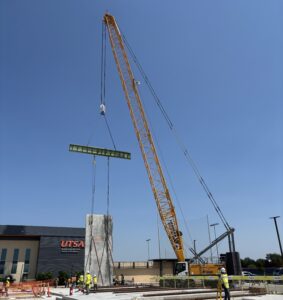
LGH’s multi-lug lifting beam and sheave blocks were employed to install tilt walls at the University of Texas San Antonio.
What does below-the-hook mean?
“Below-the-hook” refers to attachments for cranes, hoists, and other lifting apparatuses. These attachments are designed to connect to the crane hook, hoists, shackles, or master link. You can think of below-the-hook devices as an extension of the hook. Designed to attach to and control the load’s orientation, all below-the-hook equipment features a purpose-built attachment that interfaces with the load. When a project calls for it, below-the-hook equipment is used between the crane hook and the load.
There is an array of below-the-hook equipment engineered to combat different lifting requirements. Before discussing specific equipment, let’s clarify when below-the-hook equipment is necessary instead of a simple rigging setup.
The Advantages of Below-the-Hook Equipment
Sometimes, a load cannot be controlled safely with the standard crane equipment.
For more predictable, precise, and safer lifts, below-the-hook equipment is not just ideal, but often necessary. The advantages of using below-the-hook equipment include:
Improve control of the load being moved
Distribute weight more evenly
Prevent damage to the equipment or property
Reduce variability
Improve safety and efficiency
By providing multiple pick points and balancing off-center weights, below-the-hook devices help to keep the center of gravity safely below the rigging point. If you’d like to learn more about center of gravity, check out this blog post about how to calculate the center of gravity for rigging.
Overall, below-the-hook equipment reduces risks for crane lifting operations. If the risk of damage or incident is high, below-the-hook devices make all the difference in ensuring a smooth lift.
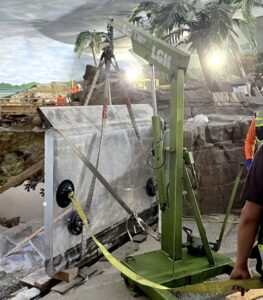
LGH floor crane lifting a glass panel for a new shark exhibit at SeaWorld San Diego.
Selecting Below-the-Hook Gear for Your Project
When coming up with your rigging plan, there are several factors to consider. Determining each of these factors will help you choose the right below-the-hook equipment for the project. Here’s what you need to know:
The dimensions of the load
Capacity and weight of the load
The load’s center of gravity
Number of pick points on the load
Environment of the jobsite
Available headroom
Below-the-hook lifting gear determines how a load is controlled, and it’s vital to select the proper equipment. No one wants to realize they don’t have the right equipment when it’s time to execute the crane pick. The clearer your requirements, the easier it is to determine the best below-the-hook devices for your job. LGH offers rigging lift planning to further help with equipment selection.
Common Below-the-Hook Equipment for Cranes
To ensure smooth lifts across construction and industrial environments, LGH offers a diverse range of below-the-hook lifting equipment. If you’d like to discover all of the essential rental equipment for crane companies,this blog post is a good resource. For now, let’s look at the most popular below-the-hook options for cranes.
1. Lifting beams and spreader beams
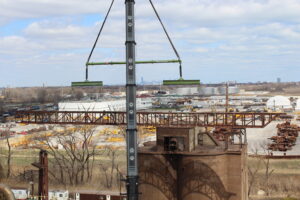
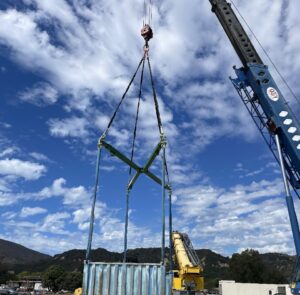
Below-the-hook lifting beam configuration for a conveyor dismantle. Image courtesy Dearborn Companies.
The primary benefits of lifting beams are the ability to stabilize loads, avoid distortion, and maintain load control. Among lifting beams, there are several options, from modular spreader bars to center pick and multi-lug, as well as telescopic spreader beams. Each type of below-the-hook beam offers similar but distinct advantages.
The modular spreader beam system includes modular struts, drop links, and end units, all to enable on-site customization. Compared to traditional lifting beams, modular spreader beams are light and use compressive forces, making them a safer, space-saving option.
Whereas multi-lug beams add flexibility to complex lifts with multiple pick points to balance uneven loads and maintain stability.
The STR9+ telescopic spreader beam lifting a load at Froedtert Hospital in Wisconsin.
The Greenfield 30-Ton X Beam in action.
Telescopic spreader beams feature a compact, collapsible design allowing for on-the-fly adjustments. The X beam, or 4-way telescopic spreader beams, along with beams that have dual extensions, are among the options to help keep your projects moving efficiently.
2. Sheave blocks and shackles
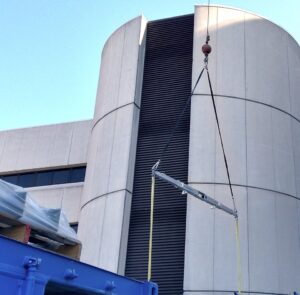
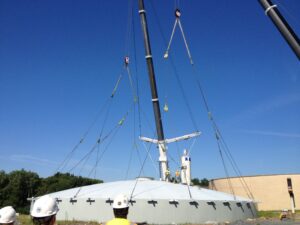
Sheave blocks and wire rope sling lifting a circular dome tank.
Shackles are an essential connection point between the crane’s hook and the load being lifted. This common piece of equipment comes in an extensive range of shackles to suit any lift.
Additionally, sheave blocks are a handy below-the-hook tool to reduce the force required to lift heavy loads, utilizing a system of rope pulleys. Multi-sheave systems increase the lifting power for crane operations.
3. Beam clamps, barrier grabs, magnets
Let’s say you need to grip sheet metal, beams, or glass. Beam clamps, barrier grabs, magnets, and plate clamps provide secure lifting without scratches or slippage. This versatile below-the-hook equipment securely attaches to the load you are lifting when standard devices won’t work.
Beam clamps are engineered to reliably clamp onto the flange of an I-beam or structural support. Barrier grabs, also known as barrier clamps, are ideal for positioning or lifting barriers. Alternatively, magnets and other specialty lifting devices can provide smooth lifts without mechanical clamps.
4. Pallet lifters and man baskets
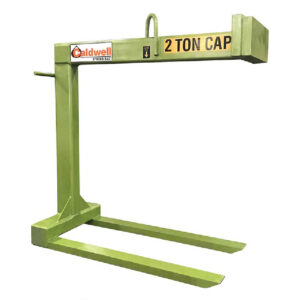
Pallet lifters allow you to transform your overhead crane into a versatile pallet-handling solution.
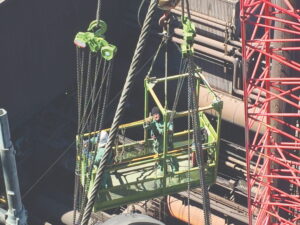
When you are looking for an efficient material handling solution, pallet lifters are dependable in any demanding industrial environment, warehouse, or construction site. For personnel transportation, man baskets can be attached to cranes to elevate or access hard-to-reach areas on construction sites.
LGH’s cantilever manbasket in operation at an energy facility in Indiana.
There are many more options of below-the-hook equipment available for cranes. Different uses call for different specialized rigging solutions.
Conclusion
Below-the-hook equipment for cranes is prevalent in most modern lifting operations. Understanding the importance and scope of the different tools available can make or break your project. If you rent any lifting and rigging gear from LGH, you can be assured that the equipment is maintained to a high standard and re-certified between every rental. The same is true for all of the below-the-hook devices mentioned above; following industry standards and going beyond best practices is the LGH way.
Contact us today to learn more about the below-the-hook equipment for cranes available in our rental fleet.
LGH is North America’s largest single organization devoted exclusively to the provision of lifting and moving equipment for rent. LGH holds the most comprehensive inventory for hoisting, rigging, jacking, pulling, material handling, and safety equipment. With over 90,000 pieces of equipment, discover your next project solution at RentLGH.com.